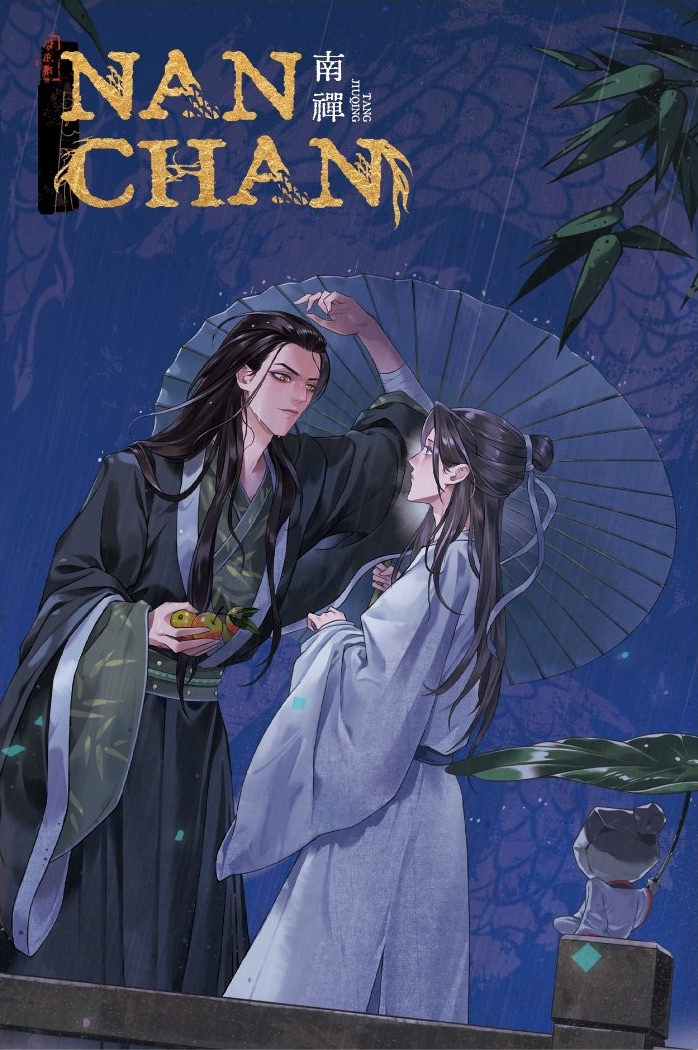
Jinglin and Cangji continue their journey as they follow the bronze bell and the suffering of man. But as they do, memories of their past begin to resurface, and their relationship may not be so simple as the former deity and his hungry pet fish.
The smile melted Jinglin’s cool demeanour and fanned the embers of Cangji’s desires into a blazing storm.
“I shall hence be the fish to your lotus,” Cangji swore, all the while fighting the urge to seal this pledge with a kiss on the hand that so effortlessly toyed with his heart.
Thoughts
After way too long I’ve finally finished the second volume of Nan Chan!
There was honestly no reason for it to take so much time before I got around to it — I only didn’t read anything whatsoever. I wanted to read it quickly once my copy eventually arrived, but alas!
I have a huge pile of books I want to get through and review. The next one is, without any question, going to be the first book of the new translation of Golden Terrace. But I digress.
The second volume of Nan Chan begins in the middle of an arc; Jinglin and Cangji are in a memory of a couple. When I began reading the volume, I had to actually pick up the first volume and read the last couple of pages to actually understand what was happening.
This is despite the fact I’ve actually read Nan Chan in the past and should know what was going on. It was just so in-the-middle of the current plot line that I got disoriented by it.
From a narrative perspective, I think it really would have been more logical to divide the series after chapter 18. It’s a more natural division, and where I presume Rosmei also planned to do it if the series had been in two volumes instead of three. But they did choose to divide this series in three, so there’s little I can do to change that.
While the volume technically is still all within the same arc, from beginning to end, there is a longer flashback about halfway. This isn’t really a problem to me. It works in the overall plot. However, I read from around early chapter 18 to the end of chapter 24 in two days and the further into the chapter I got, the more I reacted to the more archaic phrasings. First it struck me with a mob character. Then Cangji spoke archaically, and by chapter 23, Jinglin definitely was as well.
The text certainly hadn’t been written like the most contemporary piece of writing possible, because of the setting itself, as well as the themes, but it just hadn’t been… so old. I don’t find the constructions odd per se, because they’re just plain common in natural Swedish, but it was just odd to see a Swedish-style construction… which is just obsolete English grammar.
I found it fascinating (and a bit disconcerting by chapter 24) how it just seemed to gradually turn more archaic in language between the characters’ dialogue, and eventually saw it bleed into the narrative writing too. Whether it’s a feature or a flaw, I can’t say. But I certainly noticed it. As someone who does enjoy historical fiction, the tone shift is perfectly fine and I could even say justified regardless of whether it’s an original localisation choice or not, however, because of how it increased over time, it felt more like an accidental tonal drift than a purposeful choice.
And that, I suppose, bothers me just a little.
Otherwise, I very much enjoyed this, much like I enjoyed Nan Chan vol. 1. Because the story simply continues what applies to volume 1 more or less, applies to volume 2. Jinglin and Cangji’s relationship continues to develop and there are quite a lot of revelations in the second half too.
I really loved spending time with Jinglin again, and Cangji is just kind of a delight to read a lot of the time. And, naturally, it’s still one of my favourite danmei novels. I highly recommend the first volume if you like silly fish, buddhism, mystery, and gods being gods — politically.